It is often said that failing to make a decision is itself a decision — and that inaction is a form of action. The current state of the DNR timber sale program is a clear illustration of that principle. While much attention has been paid to the volume of timber offered for sale, two other metrics matter just as much to DNR and the beneficiaries it serves: revenue and removals.
How Does DNR Get Paid?
DNR operates essentially on a cash basis, funding its management work through fees retained from timber revenue rather than through borrowing or consistent legislative appropriations. For Federally Granted trust lands — primarily Common School trust lands — the management fee is 31%. For State Forest Transfer Lands (“County Trust” lands), it is 25%. These fees flow into two primary accounts: the Resource Management Cost Account (RMCA) and the Forest Development Account (FDA), the latter supporting County Trust land management. Forest health work in Eastern Washington generates revenue into the Forest Health Revolving Account, which is capped at a $10 million fund balance.
At auction, the winning bidder must submit a 10% deposit of their total bid by 4:30 pm on auction day. On a $2,500,000 sale, that is $250,000 due immediately. Purchasers also pay into the Access Road Revolving Fund (ARRF), currently $23 per MBF on the day of sale and $12 per MBF upon removal. On a typical 2,500 MBF sale, that equates to $57,500 paid at auction and an additional $30,000 paid as timber is harvested.
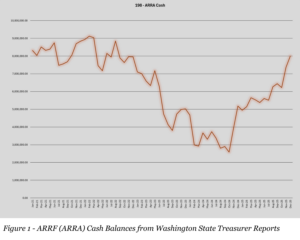 The ARRF account is critical: it funds road maintenance and engineering across DNR-managed trust lands, and approximately 67% of its revenue arrives on auction day. When few sales are offered in a given month, cash inflows to ARRF drop sharply. As auction volumes fell throughout 2024, the ARRF balance neared catastrophic lows (see Figure 1). Recovery came from three sources: a DNR cost-savings program, approximately $700,000 in previously uncompleted transfers from the Forest Health Revolving Account, and a nearly 26% increase in ARRF rates effective October 1, 2025. What is not widely appreciated is that this rate increase functions as a backdoor management fee increase — one that the beneficiaries have largely been unaware of.
Why Are Removals So Important?
“Removals” refers to the process of a purchaser shipping logs from a sale area to their destination, such as a sawmill. DNR invoices purchasers each billing period based on the volume removed and the applicable rates. This ongoing revenue stream is what sustains the RMCA and FDA account balances between auctions.
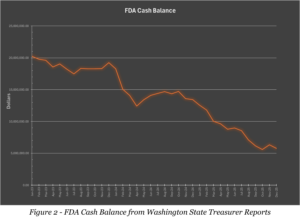
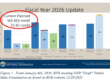
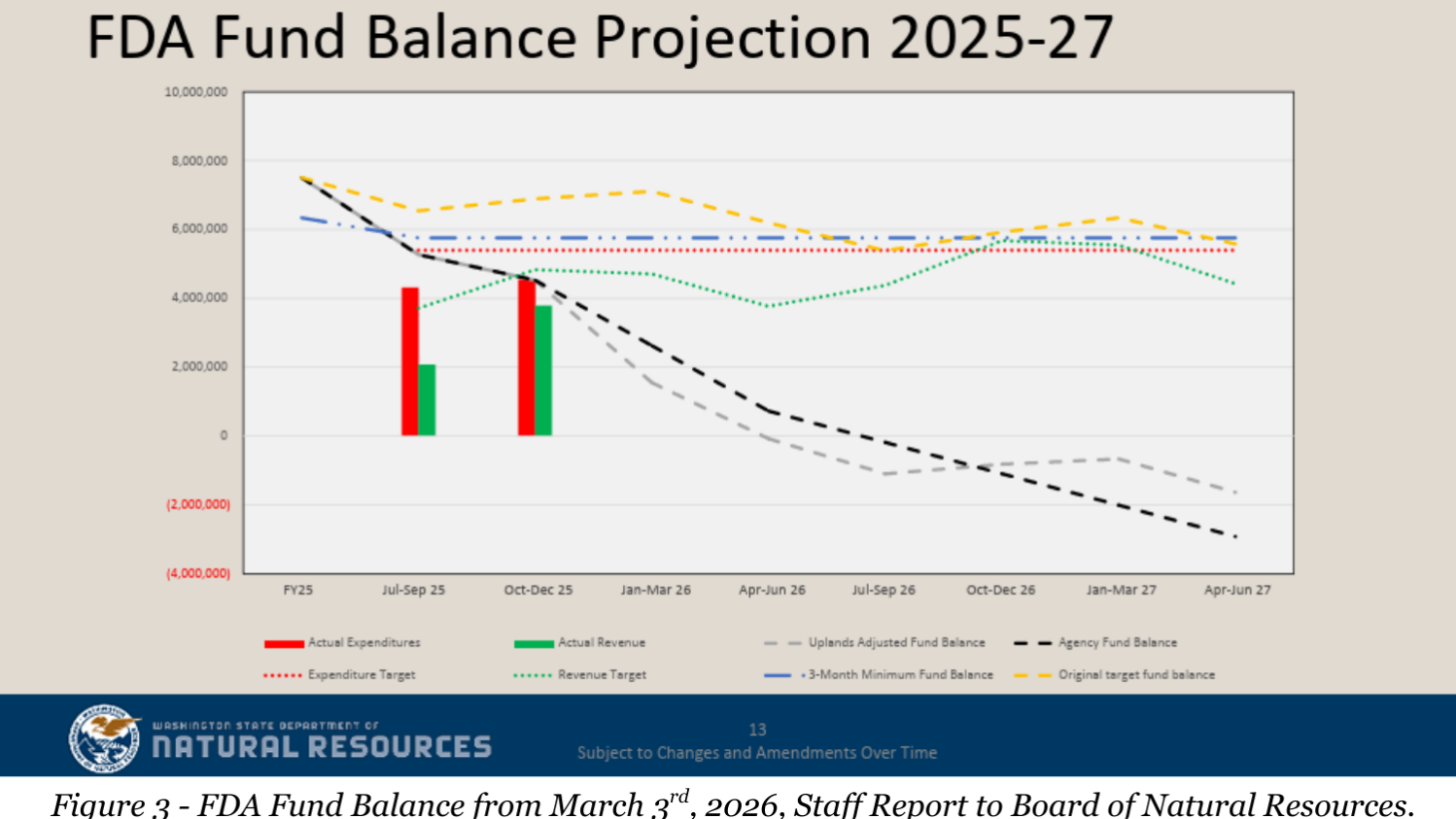
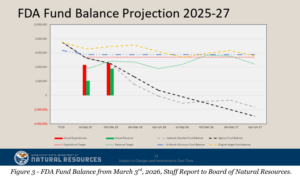
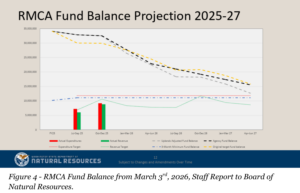
The significant reduction in volume offered in Western Washington during the final year of the Franz administration, followed by a nearly eight-month pause in timber sales under the Upthegrove administration, has taken a serious toll on all three management accounts. Because paused sales are disproportionately concentrated on County Trust lands, the FDA has been hit especially hard. As shown in Figure 2, the FDA cash balance has declined sharply. DNR’s own accrual-basis chart, presented at the March Board of Natural Resources meeting, shows the FDA ending December 2025 at just under $5 million (see Figure 3). The RMCA Uplands account is in somewhat better shape, but it too is on a significant downward trajectory (see Figure 4).
 Removals are also down due to factors outside DNR’s direct control — weather, lumber market conditions, and the availability of logs from other sources. But the delay in offering sales compounds these market headwinds. Sunk costs accumulate on sales that have been laid out but not moved forward. Staff time continues to be spent reviewing sales for which paperwork is complete, but Board approval has not been granted. Litigation expenses add further drag. Together, these costs undermine both DNR’s financial stability and the economic health of the beneficiaries who depend on this revenue.
The Impact on Beneficiaries
The numbers at the county level tell a stark story. Skagit County beneficiaries received well over $8 million per year from 2016 through 2021. By 2025, that figure had fallen to $2.86 million. In Thurston County, where County Commissioners have actively opposed timber sales in the Capital State Forest, revenue to the county and its taxing districts collapsed from $6,398,974 in 2022 to just $830,335 in 2025, an approximately 87% decline. The local school districts of Olympia and Tumwater, the Timberland Regional Library system, and local fire and EMS services have all absorbed the impact of that loss.
Since July 1, 2025, planned Western Washington sale volume has fallen nearly 38%, dropping to 361,000 MMBF. After eight of the twelve months of Fiscal Year 2026, DNR has reached only 58% of that already-reduced target. Making matters worse, the sales DNR has been offering are worth less: the statewide average sale value dropped from just over $406/MBF in February 2025 to just over $308/MBF a year later, as the agency has been steering away from its more valuable and more contested sales.
What Comes Next
Cost savings and accounting adjustments can only delay the inevitable. Unless DNR takes bold steps to move the substantial volume of sales currently on hold, the financial trajectory for the RMCA, FDA, and ARRF accounts will continue downward, and beneficiary revenue will continue to erode. DNR has scheduled a special Board of Natural Resources meeting for March 16 at 1:00 PM to approve timber sales for the March and April auctions. The outcome of that meeting will set the course for the remaining months of Fiscal Year 2026.