The first half of FY2026 produced the lowest timber sale volumes in Western Washington in 22 years. DNR was only able to sell 114,391 mbf (thousand board feet), just 25% of the 459,000 mbf it told the Board of Natural Resources (BNR) at the January BNR meeting that the Department planned to sell this fiscal year. While the focus of our reporting and the Commissioner’s “Pause” has been on Western Washington timber sale outputs, the sale program in Eastern Washington is not looking positive either.
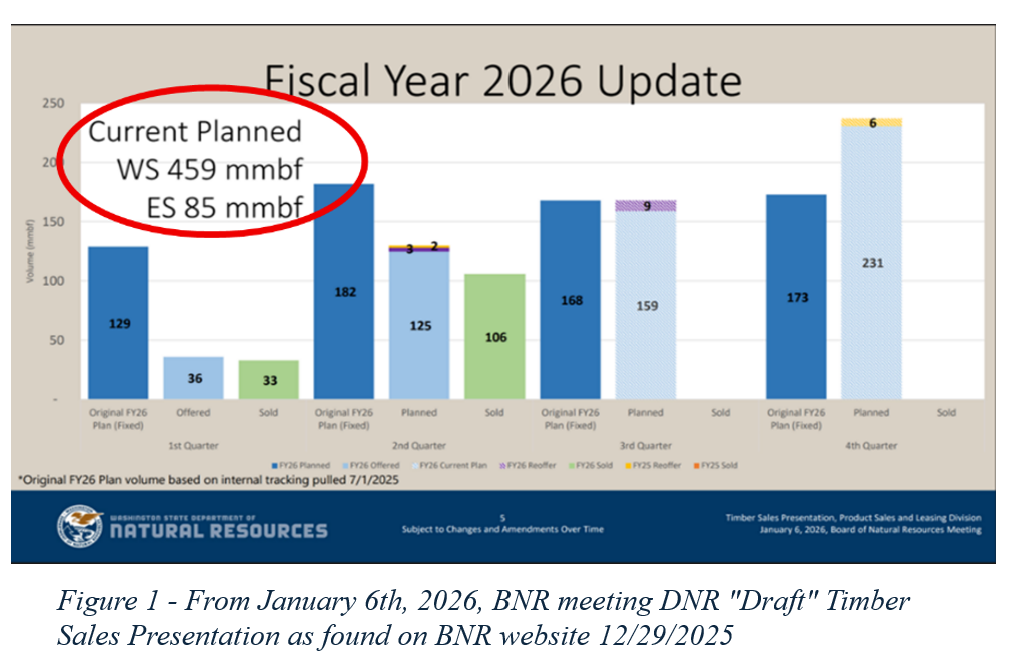
One challenge to accountability is the ever-changing “target” DNR tells the BNR it plans to hit in Fiscal Year 2026. At the January 6th BNR meeting, DNR staff presented a plan to offer for sale a total of 544,000 mbf in FY ’26, or 459,000 mbf in Western Washington and 85,000 mbf in Eastern Washington (see fig 1). DNR maintains two separate and distinct Sustainable Harvest Calculations, one for Western Washington and one for Eastern Washington, which is why the numbers are reported broken out as shown below.
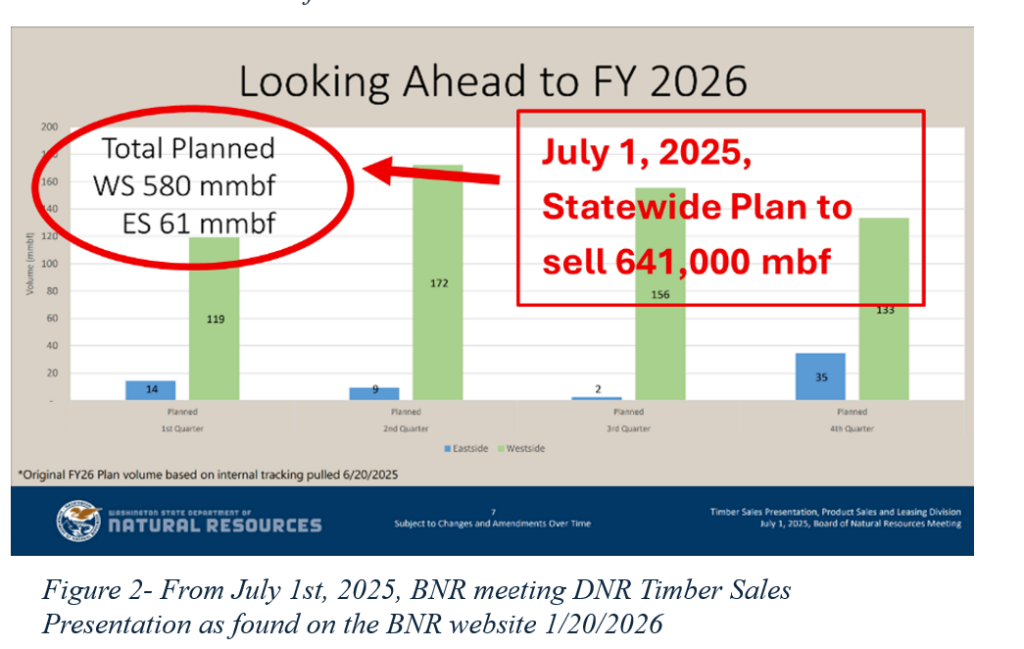
 But let’s look back just a short seven months ago at what DNR staff then presented to the Board as a planned FY ’26 target. The July presentation showed a planned combined sale volume of 641,000 mbf statewide (see fig 2). An ambitious Western Washington plan and a roughly average Eastern Washington goal.
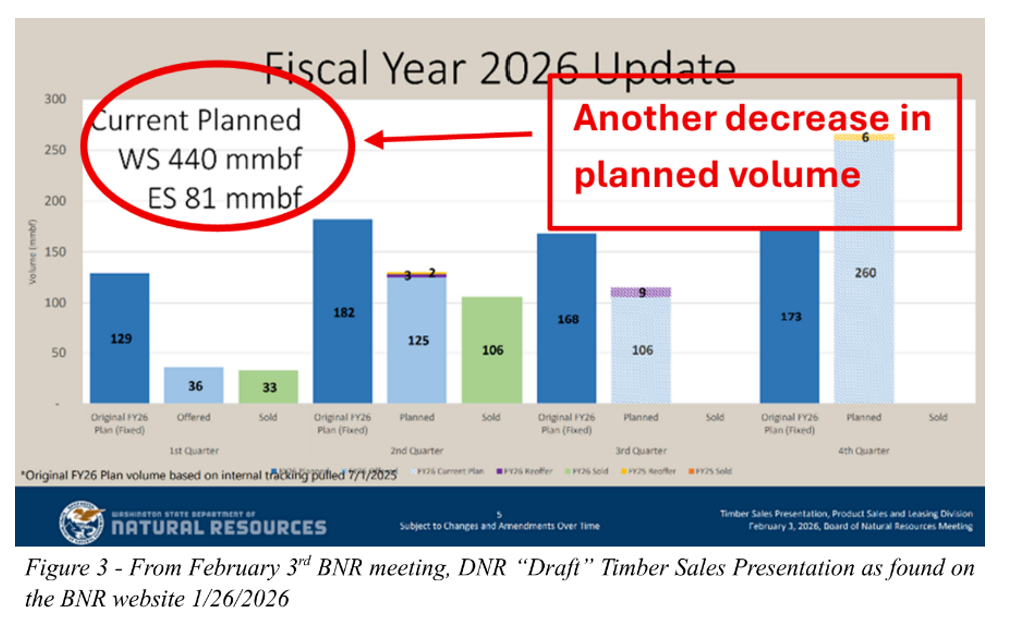
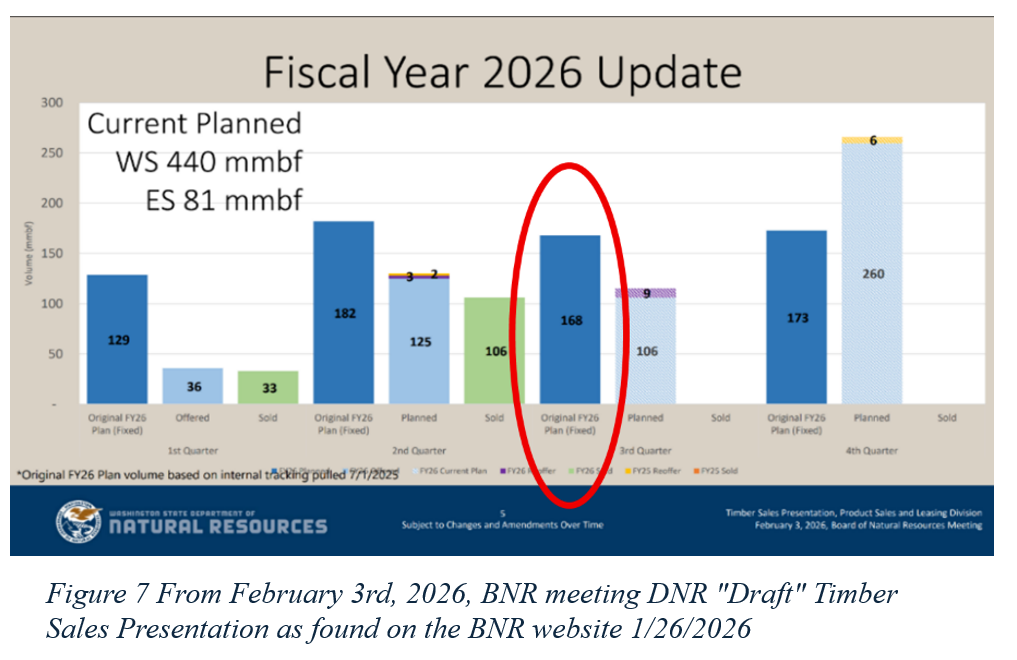
 But now, reviewing the draft timber sale presentation for the February 3rd BNR meeting, we see another decrease in the planned sale volume. DNR is now forecasting a Western Washington volume at 440,000 mbf and Eastern Washington volume at 81,000 mbf, for a total statewide volume of 521,000 mbf (see fig 3). This 120,000 mbf reduction in planned volume would be enough to operate roughly 1.5 to 2 sawmills for a year, or about 7,500 standard-size homes. Since the development of this article DNR has recently updated their slide in Figure 3. The current version now shows Current Planned as WS 433,000 mbf and ES as 78,000 mbf. Further questioning what the fiscal year target even is. Since July 1st, 2025 the planned volume has now fallen by 147,000 mbf in Western Washington. Additionally, the value of these sales is also decreasing, which could affect the economic viability of the Department.
 What is driving the ever-changing and decreasing volume predictions in Western Washington?
We know that field staff have been and continue to work hard to meet targets and bring sales to the auction table, despite constant shifts in policy and decision-making from leadership. Add to the shifting changes at the Executive level, the efforts by some Board of Natural Resources members, such as Superintendent of Public Instruction Chris Reykdal, to manage on a ‘sale by sale’ or even a ‘unit by unit’ basis within a timber sale, make it even more difficult to keep timber sale volumes up. Fellow Board member, Dr. Dan Brown, the Director of the School of Forestry and Environmental Sciences at the University of Washington, raised the concern about this piecemeal decision-making at the January BNR meeting. Stating that approving timber sales on a ‘sale by sale’ or ‘unit by unit’ basis is “reckless”.
In the updated chart in fig 4, you can see the monthly change in the Western Washington volume target, as presented to the Board.
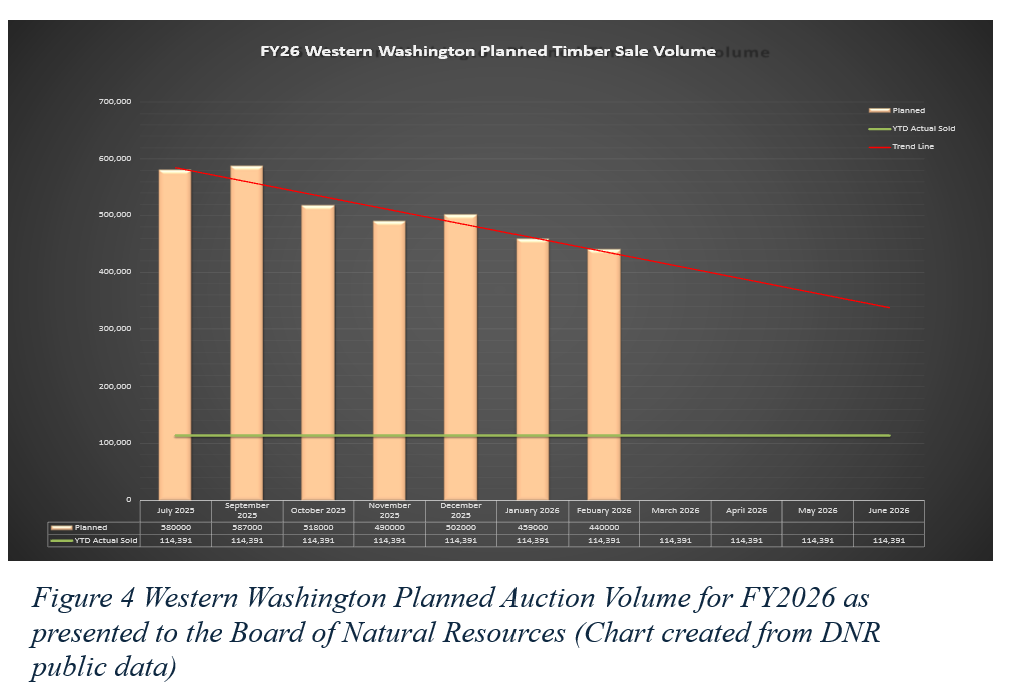 The green line in the chart to the right represents the total Western Washington Sold Volume year to date through the December auction. The red line is a simple linear trendline fitted to the data. It is expected that this trend line will flatten in the months ahead, but it indicates the challenges DNR faces in offering timber sales.
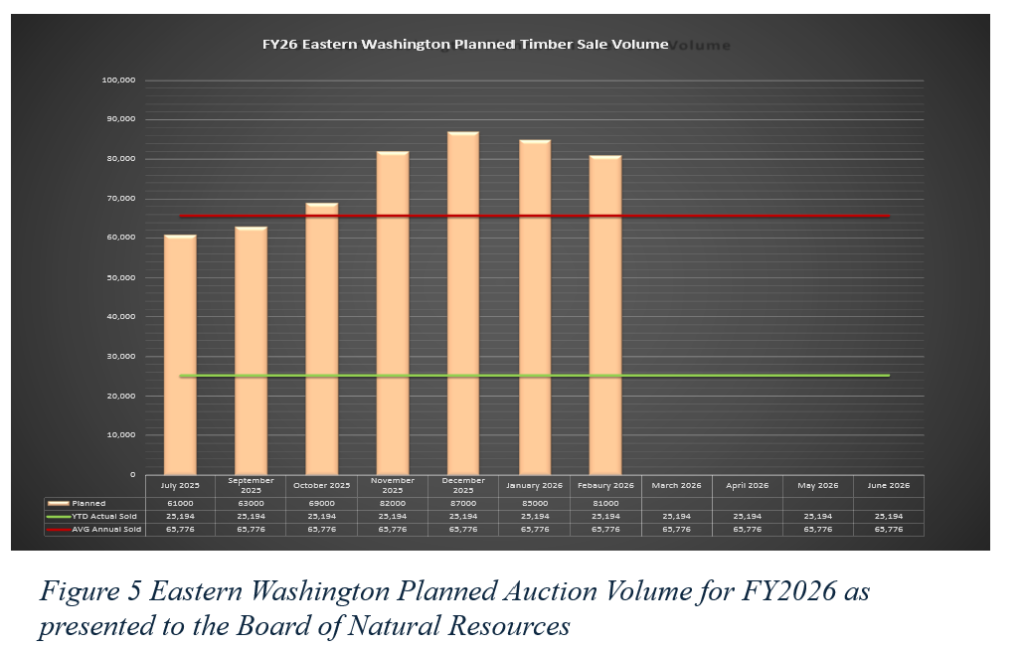
The chart for Eastern Washington (see fig. 5) looks promising, but history may tell a different story. We need to look back to Fiscal Year 2022 to find the last time DNR sold more than 70,000 mbf in a single year in Eastern Washington. And the last time they broke the 80,000 mbf threshold was way back in FY 2007. As you can see, the green line showing year-to-date (through the December auction) sold volume has a long way to go to reach the current proposed target of 81,000 mbf. The red line represents the historical average annual sold volume of 65,776 mbf in Eastern Washington for Fiscal Years 2005 to 2025.
 It is expected that DNR will bring several fire salvage sales to auction in the coming months, including the Crown Creek Fire Salvage project, with roughly 11,874 mbf. But time will tell whether these sales will sell at auction, as they can be high-risk, especially given the time since the fire occurred. With only four months of auctions left in Fiscal Year 2026, it is unclear whether the Department will reach the 25-year sold-volume auction level.
Q3 Outlook.
In our previous article, we noted that the DNR will need to sell 97,440 mbf in March 2026 to meet the Q3 target of 168,000 mbf. However, that now appears unlikely after DNR published its “draft” timber sale presentation for the February 3rd Board meeting. That document shows only 42,600 mbf proposed for Board approval. This would result in them missing their Q3 target by 17% or 27,960 mbf.
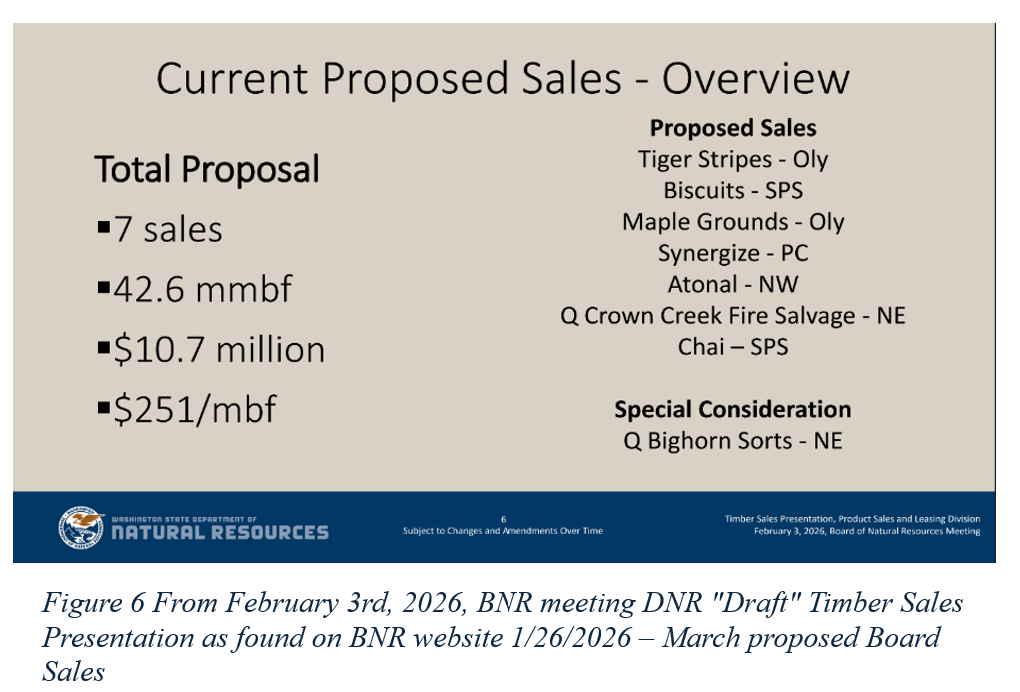 However, the February 2nd update of the timber sale presentation now shows only 40,600 mbf to be offered in March.
It is possible that, as with the January auction, DNR will add timber sales to the February and March auctions to help make up the nearly 28,000 mbf shortfall for Q3. But where these sales occur is critical to both the targets and the beneficiaries. As previously mentioned, the Western and Eastern Washington volume targets are separate. While DNR shows the Q3 gross target in the chart below, it is critical to understand how the Western and Eastern Washington numbers factor into both the Q3 and Q4 targets. The distribution of revenue DNR receives from managing these lands varies not only between east- and west-side lands but also among the various trusts.
 DNR receives a management fee for the work it conducts on state trust lands. For lands in Trust 01 – State Forest Transfer Lands, this is 25% of the sale revenue, deposited into the Forest Development Account (FDA), plus any additional road fees, deposited into the Access Road Revolving Account (ARRA). For most Federally Granted lands, such as Trust 03 – Common School, the management fee is 31%, which is primarily deposited into the Resource Cost Management Account (RCMA), and road fees are deposited into the ARRA fees. For most of the forested trust lands in Eastern Washington, revenue initially flows to the Forest Health Revolving Fund (21Q) to cover expenses. This fund has a $10 million cap; any non-encumbered amount above that cap is distributed to the beneficiaries. DNR also captures ARRA fees with the Forest Health (aka 21Q or just Q) sales.
These management funds cover staffing, contracting services, seedling purchases, road maintenance, and other forestry-related land management services. Sunk costs associated with timber sales prepared for but never auctioned, less volume sold resulting in reduced ‘day of sale fee’ revenue, and changing market conditions will impact these management funds.